
 Michael Marx on Corporate Campaigns in the USA
  Losing language and culture in Xinjiang
  Manila’s EV ambitions confront economic and energy realities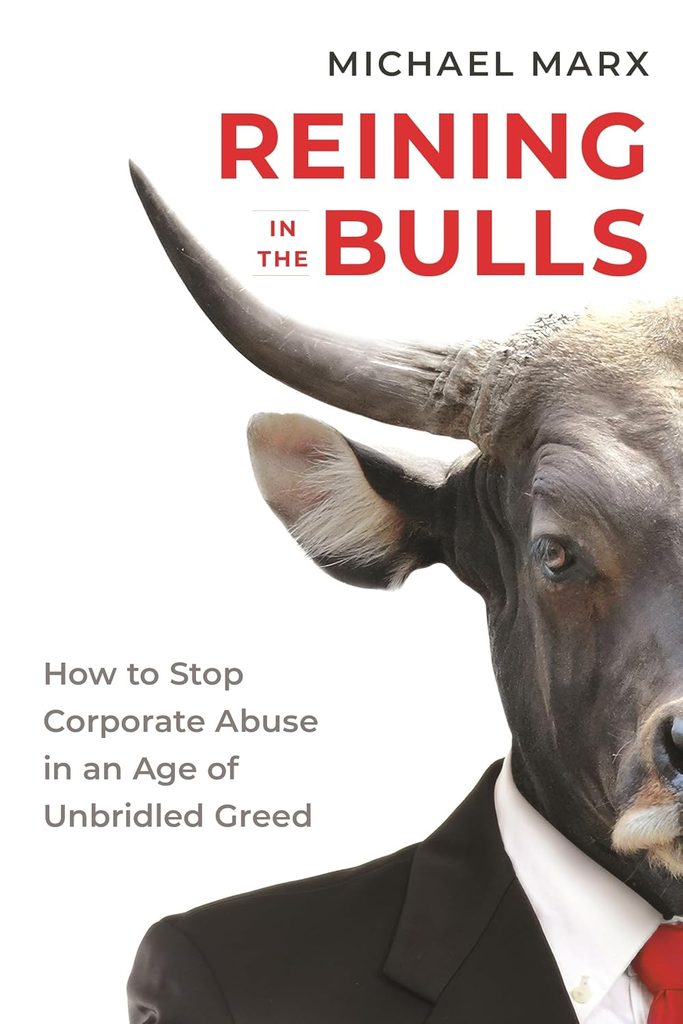
When Michael Marx started his career running corporate campaigns, he looked around for a book on how to do them. There were none.

So now, thirty years later, he has decided he should be the person to write one. And the book just out – Reining in the Bulls: How to Stop Corporate Abuse in an Age of Unbridled Greed (Princeton University Press, 2026) – is the first comprehensive resource for professionals of nongovernmental organizations who want to understand, plan, and execute modern corporate campaigns.
Marx is a pioneer in this field and has led multiple high-profile campaigns, pressuring companies that were harming workers, communities, and the natural environment.
He draws from his and other campaign experts’ experience to highlight lessons from both US and international campaigns.
Marx says corporate campaigns require knowing how to pressure branded companies and understanding their inner workings to strategically target that pressure.
“The need for a comprehensive guide is growing,” Marx writes. “Few advocacy professionals receive training on how to conduct these campaigns effectively. Even those who have worked on corporate campaigns for a while need to evolve their strategies to incorporate advances in social media and the threats posed by new industries, such as AI.”
“There is an urgent need to curb the destructive behavior of corporations, and this book gives advocates a powerful tool for holding companies accountable and protecting our social and environmental well-being.”
“When I started working on corporate campaigns, I looked to find out – how do you do these corporate campaigns?” Marx told Corporate Crime Reporter in an interview last week. “And there was no book, there was no guide. There were campaigns like the INFACT campaign against Nestle’s infant formula, the campaign against apartheid, and tobacco.”
“And after being in this movement for thirty years, there still was no book out there on how to do these campaigns. I felt that it was important to write a book that had a very systematic, step by step explanation on how to do these campaigns.”
“The idea was to give university students an idea of what corporate campaigning is like. What have we learned? What works? What doesn’t work?”
“Through Princeton University Press, we are trying to get the book adopted for classes in sociology and environmental sciences and business ethics, among other classes.”
What are the model campaigns you point students to learn from?
“A good example is the Great Bear Rainforest Campaign. That was a campaign designed to save the last contiguous stretch of temperate rainforest in North America. It was an example of how we can do good international work. But then within the United States, we had groups going after the customers of the logging companies that had the rights to log the last 68 pristine valleys of this rainforest down the British Columbia coast.”
“Greenpeace, NRDC and the Sierra Club and the Rainforest Action Network were going after customers in the United States and Europe and in Japan. It ended up being a remarkable lesson also in how to negotiate. We were negotiating with the executives of the three major logging companies that had the rights to log these valleys.”
“And it evolved from that contentious state into more of a problem solving state where we became more collaborative in trying to solve the problem. The companies were required to hire a certain number of employees in these logging operations as part of the deal for getting the concession.”
What was the result of the campaign?
“Ultimately, British Columbia agreed that they would not allow any logging in those forests, the companies agreed that they would go out and get their logging operations independently certified in other areas. And we would agree to promote certified logging. And we turned the power to control over the logging in the Great Bear Rainforest to the native communities.”
Give us another example.
“Walmart. I wrote a paper saying that we needed to have more of a united civic society approach to Walmart. They are like the White House of the marketplace. They have executive authority over their suppliers. They have so much influence and control of the market share.”
“We ended up bringing in a diverse set of allies – people concerned about historical sections of their cities being replaced by huge Walmart stores, labor activists, a diversity of environmental groups. Walmart had at the time somewhere in the neighborhood of 80,000 suppliers. I think today it’s more like 100,000 suppliers. Walmart was affecting the environment in so many different ways from farmed salmon in Chile, to packaging without recycled fibers, not to mention the energy waste of their stores and transportation.”
“It ended up being a great coalition. And this paper found its way from Conservation International into Rob Walton’s hands. He was on their board at the time. He contacted Lee Scott, the CEO of Walmart who then scheduled for me and three or four other activists from NRDC, World Wildlife Fund and Conservation International. And they spent a day with WalMart executives. I was the bad cop, laying out why we were coming after them. The others were the good cops, saying – look here are all of the positive things you can do to save you money.”
“That conversation ended up leading to WalMart committing to bringing in all kinds of inside consultants to help them change the way they operated. Six months later they invited us back and announced all of these changes which were going to save them a lot of money. But it was right along the lines of the things we were demanding.”
What was a demand that you made that they agreed to?
“One of the demands was that they move toward more clean energy in their stores and transportation. Lee Scott later announced that they had set a target of reducing their overall energy consumption by 25 percent both in their stores and transportation. I can’t remember the time frame. And Paul Hawken told me that that was probably the most significant commitment by a publicly traded corporation to environmental changes that he had ever seen.”
“And it wasn’t just about that. It was also about demanding that their suppliers use smaller, more condensed packaging, recycled fibers that Walmart could then also recycle. They also went more toward organics and certifying their fish purchases. They made a number of changes. Are they perfect? Absolutely not. Did they change a whole lot having to do with labor? No they didn’t. But it was a significant achievement.”
Are there any current corporate campaigns that you really like?
“I like the data center movement. But it’s very fragmented right now. There is a great deal of outrage. It’s in a lot of communities organizing around the country. There is a general feeling that corporations are coming in here, they have too much control, they are forcing this on us, we never had a chance to approve it ourselves and to get a sense of what the full implications of it are.”
“These are artificial intelligence companies. And people are scared about the implications of AI companies. So there’s kind of a second layer to it. My thinking is that we need to unify these campaigns and take advantage of the fact that they are crossing political boundaries. We have people who care about their environment. But also people who are very conservative, but they are feeling the pain and very concerned about it. That’s a huge opportunity.”
AI industry leaders are coming out saying that there is a big chance– 25 percent chance – that AI will kill us all. That’s remarkable. But people at the grassroots have to be wary of their movement being co-opted by the companies themselves. We use the term non profit industrial complex (NPIC). It refers to, for example, the big green groups, which are taking millions of dollars in donations from large corporations and their foundations.
We crunched the numbers on the average salaries for the CEOs of the ten largest environmental groups in DC. What do you think it is?
“$250,000?”
More like $900,000. That puts those people out of touch with regular Americans. They have no sense of what it’s like to live for a working class person in upstate New York or West Virginia or the flyover states. It’s a separate class of people.
And second, the corporations actually have their hooks into these big Green groups. I didn’t see that you addressed that question in your book.
“I did not. But I did allude to the issue, without naming names. Take when groups like Greenpeace, Rainforest Action Network, or Amazon Watch were going after the oil companies moving into Papua New Guinea. The native communities were organizing. The oil companies went out to one of the big greens and said – how can we do this sustainably? They used that advice and the fact that they put a nice big chunk of change in that big green group’s pocket as political cover against the other groups and native communities.”
“One of the things I warn about is – before you start a campaign, think about where this company might go to give them a public relations shield. Make sure you go to that group and make it very clear to them that these are the demands and unless you are working with us to put those demands in place, and stay behind the scenes so that the company can’t use you as a public relations shield, then we will come after you.”
We ran a story in 2012 titled – Sierra Club Tells Members – We Don’t Take Money from Chesapeake Energy – When in Fact They Took $25 Million. This had to do with natural gas pipeline issues in West Virginia. Citizens were fighting a pipeline. Sierra Club was taking money from Chesapeake Energy and pulling its punches on this issue in West Virginia.
What’s your experience about that kind of deal between corporations and large green groups?
“I don’t have much experience there. When I was at Sierra Club for three years as the director of their Beyond Oil Campaign, I know Mike Brune had come out and acknowledged that they had received money from natural gas companies and that was a huge mistake. I think their strategy was to get out in front of it, let’s make it clear we are not going to do this again. They were also taking money from Bloomberg to go after the coal power plants across the country.”
Sierra Club’s argument was – we are fighting coal, why not take money from natural gas companies?
“Brune ended up having to acknowledge it was a mistake.”
But when Sierra Club activists in West Virginia wrote to Brune, he wrote back – “no, we will not take any money from Chesapeake” when in fact they already had.
“They have salaries to pay. They have pretty nice offices. It gets to the point where they say – we need a budget. And even though they take it from a source that we are a little embarrassed if there is too much visibility – sometimes they do that. And that becomes a problem.”
If you were designing a campaign against AI right now to regulate AI, and companies in Silicon Valley said to you – we agree with you and we would like to fund you, would you take that money?
“No.”
Why not?
“It confuses your loyalties. And it gives them too much power over you. In our campaigns, we have never taken corporate money. And it’s just because you have to have a really clear line. And you can’t have a dependence on them. If you want funding, get it from charitable foundations or a donor who you know historically is totally aligned and is not going to ask you to compromise.”
“As soon as you start taking corporate money, that builds dependence. As soon as you build dependence, that waters down the potential duration and the strength of the demands of the campaign.”
“Some of the most powerful members in your movement are the ones who are willing to go out and engage in civil disobedience. They are passionate about advocating for you. And that passion is undermined when they hear these disturbing stories like taking money from natural gas companies.”
“So you need to stay clean, particularly in the corporate campaign world.”
Clicktivism versus direct people action. What are your thoughts?
“There is a place for both and they need to complement each other. One of my concerns is that there is too much of a tendency to default to clicktivism. Ideally, you use clicktivism to generate petition signatures and gather names. That’s level one. You use that to sign open letters to the CEO. But you also then do direct action in the field so companies know that people are willing to put their bodies on the line.”
“Then in some cases, you escalate that so people are willing to engage in civil disobedience. You videotape that and you go out to your digital membership and get them to try and repeat it in their communities.”
“I gave each a chapter in the book, but it’s important to integrate them and not to default to clicktivism only.”
There is very little in your book about the military industrial complex. Why is that?
“One of the classic strategies is to threaten the corporate brand because it will harm them in terms of their customers. But for military companies, their customer is the federal government. They are harder for corporate campaigns. You could go after their employees and the potential to bring in new employees.”
“But for some corporate campaigns, you have targeted universities so the university says to the company – you can’t do employee interviews on our campus. That’s one way to target military companies.”
“But it’s tougher going after them when the government is the customer.”
[For the complete q/a format Interview with Michael Marx 40 Corporate Crime Reporter 37(12), September 28, 2026, print edition only.]
Don't Miss:
-
Losing language and culture in Xinjiang
-
Manila’s EV ambitions confront economic and energy realities
-
Tunisian court dismisses case to dissolve publisher of ICIJ partner Inkyfada
-
Prabowo Faces Growing Discontent as Jokowi Revives His Political Ambitions
-
Five years after the Pandora Papers, transparency laws lose their teeth