
 Indonesia’s Nuclear Deal with Russia is Fraught with Concerns
 Amazon mining boss wanted by Brazil for sheltering Jair Bolsonaro’s spy chief has businesses, properties in Florida
 New evidence links Singapore palm oil giant to Indonesian deforesters, despite denials
Reporting Highlights
- Scientists’ Secret Vote: A U.N. climate report legitimized carbon capture and storage, suggesting at least 99% of the CO2 would likely remain underground, despite scant empirical evidence.
- Oil Industry Favorite: Fossil fuel companies have identified carbon capture as a climate solution that will allow their industry to survive, and have pushed the U.N. and scientists to study it.
- Pattern of Underperformance: Decades later, major CO2 storage projects have suffered breakdowns, setbacks and cost overruns, while CCS remains central to climate models and policy.
These highlights were written by the reporters and editors who worked on this story.
In the spring of 2005, the United Nations convened more than 100 of the world’s top scientists in the medieval town of Oviedo, Spain. They were there to finish writing a paradigm-shifting report about a technology that they hoped could help stop climate change.
To celebrate the report’s impending completion, the meeting’s hosts handed out bottles of cava, Spanish sparkling wine, with tongue-in-cheek labels stating that they were to be opened only by those who truly believed it could work.
Belief was necessary because the technology — carbon capture and storage, or CCS — had barely been tested. The idea was simple: strip carbon dioxide from smokestacks before it could flow into the air and warm the planet. Then pump it into a porous part of the Earth’s crust and leave it there. Forever.
The experts in Oviedo had stacks of papers proving that parts of the process worked. But major questions remained about how much space exists inside the Earth to store the CO2, how effectively it could be monitored and whether the poisonous, concentrated gas would reliably stay underground.
Tasked with wrangling roughly three dozen of those scientists toward consensus was Sally Benson, a geoscientist from Lawrence Berkeley National Lab who was co-leading the report’s chapter on underground storage of carbon. After a quarter-century of studying how fluids and gases move beneath Earth’s surface, she was an unimpeachable authority on the subject. She was also a savvy and diplomatic leader, skilled at managing rooms full of big egos and big tempers. It was proving handy in a process that had at times devolved into unruly debate.
The scientists had clashed for years over what the report should say, first at a meeting in Canada, then in Norway, Australia and Brazil. The evidence was scant. Three large-scale experiments were underway, but only one — a Norwegian operation that captured carbon from a natural gas field and pumped it under the bed of the North Sea — had rigorously tested permanent storage. There, the injected CO2 astonished engineers when it floated 700 feet upward through a series of geologic formations. To their relief, it hit a ceiling of shale that kept it underground, and the project was deemed a success. But with so little to go on, the scientists warned in their first draft that any broad statement about leakage risk would be “almost meaningless.”
The researchers were in Oviedo only because Saudi Arabia and other oil-exporting countries had pressured the U.N. to write the report despite the paucity of evidence, according to U.N. officials and records. The oil, gas and coal industries had spent years casting doubt on climate change while quietly fretting that policies to address it would one day put them out of business. The industry, documents show, saw CCS as a way to forestall that outcome, allowing the world to keep burning fossil fuels while simply burying the pollution underground. A U.N. report would bring the technology into the mainstream.
In turn, the U.N. hoped such a report would draw the oil-producing nations into its search for climate solutions. So despite objections from some nations and environmental organizations, which warned that the report would distract from the imperative to phase out fossil fuels, the U.N.’s preeminent climate science authority, the Intergovernmental Panel on Climate Change, went ahead. And for the first time, it invited a large contingent of industry researchers to join the scientists in writing the report, as well as several representatives from environmental groups. Benson’s chapter included authors and editors from Shell, Chevron and Saudi Aramco.
The process that followed would make some of the chapter’s scientists uneasy. The IPCC’s procedures stated that reports should assess the existing research on a topic based on peer-reviewed literature and that exceptions must be reviewed and clearly cited.
Bert Metz, one of the highest-ranking U.N. officials at the meeting, was pressing the group to come up with more definitive language about CCS’ potential. The report would be better if it could offer hard numbers, even where none existed in the literature: Precisely how many gigatons of storage capacity did the planet likely have? How long would a well-designed reservoir hold the CO2 injected into it? More than a year? A thousand years?
With so little evidence to work with, David Keith, a Canadian physicist, proposed a workaround: The authors could conduct an “expert elicitation,” taking an anonymous survey about what they expected the evidence to eventually show.
At first, not everyone was willing to go along. Some scientists worried that making what amounted to educated guesses would mislead the public, they told Drilled and ProPublica. Benson and Metz, though, both argued that on such an important matter informed advice was better than nothing.
In the end, the group agreed to take the survey and to keep it off the record — they would “burn it afterward,” Keith recounted, making no mention of it in the official report. When the meeting concluded, some of the scientists popped their bottles of cava in celebration.
“It’s not the hard science that you would prefer, obviously,” Metz would later tell Drilled and ProPublica.
Five months later, the IPCC published its special report, which would help legitimize CCS for a generation.
The 431-page document portrayed CCS as a potential savior for the climate that could enable countries “to continue to include fossil fuels in their energy mix.” It stated that using CCS could lower the cost of stabilizing global CO2 concentrations by at least 30% and that if fully supported by policy, it could account for as much as 55% of the world’s efforts to limit climate change through this century.
It acknowledged that there were still gaps in research and experience with the technology — offering extensive detail deep within its pages about the challenges and uncertainties of piecing together separate but proven steps in the CCS process. But its summary stated that “there are no major technical or knowledge barriers” to storing captured CO2 underground.
All of those assertions, however, rested on the critical determinations made by the scientists handling the storage chapter.
Benson’s group wrote that the planet offered vast CO2 storage capacity. Storage sites that were well selected and well managed, they said, were likely to retain 99% of the carbon pumped into them for at least 1,000 years.

A Consequential Decision
The scientists’ conclusions that day in Spain have had profound, compounding consequences.
The special report has been cited in thousands of academic papers, in legislative testimony and in media coverage validating carbon capture and storage as a realistic solution to global warming.
When climate forecasters built models, their calculations assumed CCS would work. When governments and corporations began making so-called “net zero” pledges, promising to subtract as much CO2 from the atmosphere as they add, they assumed CCS would work. When policymakers gave energy companies billions of dollars in public funds to develop “clean coal,” they assumed CCS would work.
These presumptions shifted the world’s discourse from how to limit carbon pollution to how to remove it from the atmosphere after the fact.
Enthusiasm for the technology has only grown. This spring, California embarked on one of the world’s largest carbon burial endeavors yet. While President Donald Trump eviscerated most programs addressing the climate, he has expanded subsidies for CCS. There are more than 100 applications for storage sites pending in the U.S. alone. U.N. analyses suggest that to achieve environmental goals, a CCS industry the size of the entire global oil production industry would have to be built by 2050.
But 21 years after Oviedo, a staggering gap lies between expectations for the technology and its operational reality. Since 1996, just 12 large-scale geological storage projects have been constructed. Collectively, they bury less CO2 than a single power plant can emit in a year, according to our analysis of sites listed in an International Energy Agency database. Seven of them have faced technical, financial or performance issues. An investigation by Drilled and ProPublica found there’s reason to doubt carbon capture and storage will ever succeed at the scale needed to offer a significant climate solution.
Read More
Why Carbon Capture Can’t Conceivably Solve Climate Change
History is full of audacious technological leaps — moments when visionary engineering solved seemingly intractable problems. Scientists told Drilled and ProPublica that they have devoted themselves to studying CCS in that spirit, hoping a grand techno-fix could help the world solve the climate crisis without a painful overhaul of the global energy system.
But that ambition did not exist in isolation. It was bankrolled in large part by companies that stood to profit from its success.
Industry documents show that oil company executives have long seen CCS as a way to hedge against climate regulation, greenwash their brands and preserve their core business. Internal Exxon documents obtained by Drilled and ProPublica show that in 1988, the company determined that any climate research Exxon supported should serve the dual purposes of protecting the value of its oil, gas and coal while preserving the company’s business options; the company would eventually become one of the world’s major funders of CCS research.
Later, the American Petroleum Institute would write in internal communications that the industry’s “license to operate” depended on companies lowering climate pollution, and CCS, it wrote, “enables the use of petroleum and natural gas by providing an opportunity to capture and/or offset emissions.” And at a 2023 prominent oil industry conference in Houston, the CEO of Occidental Petroleum, Vicki Hollub, would explain that a novel form of CCS that sucks carbon directly from the air “is going to be the technology that helps to preserve our industry over time.”
For many university faculty, the rewards for studying the industry’s favored climate solution have been numerous, opening opportunities, funding papers and raising their profiles. Benson is a clear example. When the IPCC was awarded in 2007 with the Nobel Peace Prize for its climate work, she and her co-authors were recognized among the scientists who contributed. When Stanford University sought a new director for its ExxonMobil-funded climate research center, it tapped her. When President Joe Biden prioritized climate policy, he brought Benson into the White House.
Keith, the Canadian physicist, benefited from oil industry interest in a different way: He developed technology to capture CO2. Occidental Petroleum paid more than $1 billion to buy the company he founded.
There is no evidence that Benson, widely described by colleagues as scrupulous, skewed her scientific findings to suit the interests of her industry patrons, and Benson has described CCS’ flaws in her publications.
However, in speeches, presentations and even congressional testimony, she has been a dogged champion of CCS technology, time and again describing it as safe and ready for large-scale deployment, despite having a ringside view to its many setbacks.
She has frequently referenced the most affirmative statements from her group’s work in Oviedo as evidence. But the methodology Benson and her co-authors used to reach those conclusions 21 years ago has not been generally understood. When Drilled and ProPublica told prominent climate researchers about the expert elicitation process, several were disconcerted to learn that there was so little scientific basis for the report’s conclusion that 99% of CO2 was likely to remain underground.
A survey, said Oliver Geden, a vice chair of the IPCC’s forthcoming climate assessment, was “an inappropriate way of assessing the literature.”
Authors “are not supposed to do original research. They’re supposed to just collect what’s out there,” said Roger Cooke, who was a lead author on a subsequent IPCC report. Cooke said expert elicitation, done rigorously, can be valuable, but “just asking a bunch of experts to give their best guess is one of the worst things you can do.”
In a detailed written response, Benson said she did not believe that the survey undertaken in 2005 violated IPCC norms and said the group’s leadership was aware of the process. She disputed that the approach amounted to an informed guess and said that “there was an enormous amount of data” to draw on. The group was trying to agree on the best language to synthesize evidence detailed deeper in the report. She rejected the notion that her research or career were influenced by industry funding, writing that she has worked “tirelessly for 30 years on CCS and other climate solutions” in a sincere effort to combat an escalating planetary crisis. And, she offered, she views CCS as one valuable tool among many needed to address climate change.
Keith said the goal of the expert elicitation was not to seek precision, but to provide a sense of the orders of magnitude of the capacity and risks, “because that’s what’s relevant to public policy.” He said even sites with problems haven’t leaked large amounts of CO2 and that the report’s broad statements “have stood the test of time.” The chapter authors’ confidence in CCS doesn’t suggest “that a bunch of us are tools of the fossil fuel industry.”
The IPCC declined to comment on specific questions about how the report came about. “We are not in a position to comment on individual recollections,” a spokesperson wrote about the expert elicitation. However, they said that the group’s process was in keeping with the organization’s procedures at the time and that it reflected contemporaneous understanding of the technology. The IPCC did not directly respond to the assertion that the authors conducted what amounts to new research during the writing process, and it did not provide requested records that would detail the scientists’ vote. “The IPCC’s role is to assess the full range of available scientific knowledge,” the statement said. Metz referred to the IPCC’s response.
Chevron, Shell and Saudi Aramco did not respond to requests for comment.
Drilled and ProPublica spoke with more than 100 experts on carbon capture, climate modeling and influence in academia, including a dozen people who attended the Oviedo meeting. We compiled records of geologic storage tests and surveyed an extensive body of peer-reviewed literature. This investigation is part of a broader examination into how fossil fuel industry funding of climate research has shaped climate policy, solutions and public understanding. It follows our report in June about a BP-funded program at Princeton University and the oil company’s role in crafting one of the program’s most influential climate papers.
Since Benson and her co-authors met in Oviedo, weather catastrophes have multiplied, oceans have acidified and the amount of carbon in the atmosphere has soared. In September, the U.N. released an urgent new report declaring that the race to avert disruptive warming has been all but lost. It concluded that “overshoot” — the notion that temperatures will rise above the world’s adopted goal of 1.5 degrees Celsius of warming — is now a certainty.
Carbon capture and storage, it said, is one of the only ways to bring those temperatures back down.

Looking at a Failure and Calling It Triumph
Just a few days before the meeting in Oviedo, BP put Benson and a handful of other scientists on a chartered flight from London to Algeria. Their destination: the world’s second major geologic carbon storage experiment, in the Sahara.
The British oil giant, along with the state-owned oil companies of Algeria and Norway, had begun to drill for gas at a new field named for a nearby oasis called In Salah. Most natural gas comes out of the ground as a cocktail of methane and CO2. The CO2 must be stripped out and is usually vented into the sky. But at In Salah, the companies saw an opportunity to try out a greener process — one that could become big business.
Earth’s crust is a layer cake of rock. Some layers, like sandstone, contain honeycombed pores capable of holding CO2, while others, like mudstone, can act as impermeable seals, trapping the buoyant gas underground.
That layer cake is impossible to precisely chart from the surface, but engineers sent sound waves into the ground and interpreted what echoed up into rough maps. They learned their target sandstone reservoir sat below a 3,000-foot-thick brick of mudstone they believed would be impermeable. They also learned the sandstone was “tight” — less honeycombed than they had hoped — but still capable of holding gas. So they had begun to inject the CO2.
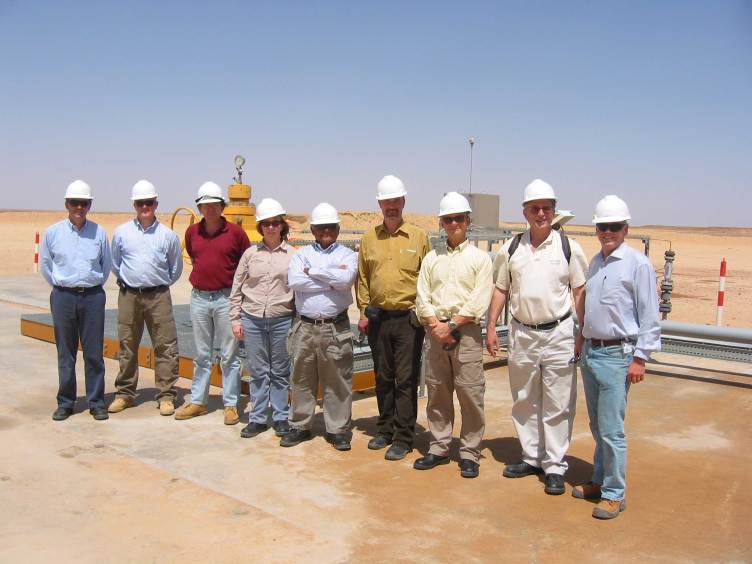
The plane landed on a sand-strewn strip circled by jeep tracks and rocky plateaus. A photograph shows Benson, medium height, her blond bob tucked beneath a hard hat, standing in the desert alongside a BP-funded physicist from Princeton named Robert Socolow and seven other men in front of a well that was pushing CO2 under the desert. In Salah had been operating for less than a year but seemed to be going smoothly.
Afterward, Benson traveled to Oviedo to finish drafting the special report, which listed In Salah among key sites that “indicate that it is feasible to store CO2” underground at significant scale.
That assessment has not held up.
Energy companies had first begun pumping CO2 into the ground commercially in the 1970s, when they realized it would loosen up stubborn crude oil, sometimes doubling an oil field’s output. They called it “enhanced oil recovery,” and though they didn’t try to lock the CO2 in place, much of it seemed to stay underground.
The idea to use carbon injection as a climate fix came a few years later from an Italian physicist named Cesare Marchetti, who suggested disposing of carbon deep in the ocean or underground. In the 1980s Exxon tried, and gave up on, efforts to develop the idea. And it wasn’t until 1996 when the first large-scale CCS project — the operation in the North Sea — began.
In a recent interview inside her narrow, fluorescent-lit office at Stanford University’s earth sciences building, Benson said it was shortly after that that she first heard of CCS. A colleague at the Department of Energy had sent her a slide deck by Princeton’s Socolow about the technology. “I was like, ‘I think this is nuts,’” she told Drilled and ProPublica.
“I just couldn’t really picture it working at scale.”
But, as both an idealist and a pragmatist, she was drawn to the potential for science to solve difficult environmental problems. She made a crude calculation of how much CO2 might fit beneath California and was surprised by the answer: a lot. At least in theory. And it changed her mind.
As Benson became one of CCS’ leading experts and champions, she increasingly found herself in rooms full of oil industry veterans. In 2000, she helped establish a partnership between the Department of Energy and companies including Chevron, Texaco and BP. That program had a focused mission: make large-scale geological storage an operational reality by 2015.
In 2002, Benson was asked to sit on the advisory council of a new BP and Ford Motor Co.-funded climate research center at Princeton University. At a summit there the following year, Benson expressed concern that focusing on leaks could undermine public support for CCS, according to meeting records and the account of another person in attendance.
“Need to present optimistic estimates,” the minutes recapping her presentation say.
By 2007, Benson was helping to run her own industry-funded research center. A few years earlier, ExxonMobil CEO Lee Raymond, a thunderous voice of climate denial, had put up $100 million of the company’s money to fund climate and energy work at Stanford University. With another $125 million from three other companies, Stanford’s Global Climate and Energy Project became one of the best-funded climate research centers in America.
The donation came with strings: ExxonMobil and the other sponsors had veto power over which research projects received funding.
Students and activists protested the funding structure, accusing ExxonMobil of retracing the path of tobacco companies, which paid for scientific work on obscure causes of cancer as a distraction from their culpability.
Benson defended the arrangement ardently and often. ExxonMobil and the other sponsors approved every grant that Stanford recommended, never exercising their veto power, she said. Reporting by Drilled and ProPublica did not contradict that assertion. Benson also pointed to the fact that the program funded an array of research, including on renewable energy.
In an interview and written response, Benson said researchers who take funding from oil companies are motivated not by corporate agendas, but by genuine interest in the work. The funding underwrites the inquiry, she said, not its conclusions. Where there’s “alignment,” she added, the industry support can be “amazingly catalytic and helpful.”
In response to a request for comment, Stanford University directed Drilled and ProPublica to former law school dean Paul Brest, who led a committee that reviewed energy research funding at the school. Brest said that faculty have a right to seek any funding they choose, so long as sponsors cannot direct the work.
Most important to Benson was that scientists and their students have the opportunity to research matters of great consequence. She has published more than 50 papers on geologic carbon storage since joining Stanford, most of them highly technical evaluations of CCS that reiterated its importance to reducing emissions, and many underwritten by ExxonMobil and other industry sources. “I don’t know anybody else,” she told Drilled and ProPublica, “who would eventually provide, you know, $225 million of funding” to study climate solutions.
But whether researchers intended to serve their funders’ agenda on CCS or not, some say the effect has been undeniable. “It seems like a credible solution because you have credible people at credible institutions working on it,” said Naomi Oreskes, a Harvard historian of science and an expert in corporate influence.
Benson was still getting settled into her new job at Stanford when the project in Algeria ran into major problems.
On a 118-degree day in 2007, In Salah’s inspectors heard CO2 whistling through the top of an abandoned oil well nearly a mile from the nearest injection site. Engineers had believed it would take years before the CO2 plume could spread so far underground, but the gas had cracked through the sandstone and found a new path.
To stop the leak, workers poured cement into the well, plugging it permanently. But soon a second problem arose: Satellite data revealed the desert floor above the injection sites had bulged. When project engineers again used sound waves and other tools to map the layers underground, they arrived at an alarming discovery: Pressurized CO2 had sent cracks a quarter of the way up through the 3000-foot-thick layer of mudstone. If it breached the rest, it could leach into the pan-Saharan aquifer, acidifying a source of drinking water millions of people depend on.
BP and its partners eventually summoned Benson and the other science advisers to London. The dangerous gas, they could now see, was moving in ways they had predicted it could not. Nonetheless, the advisers suggested that injection proceed temporarily to see whether it could safely be done under lower pressure and with careful monitoring.
But the Algerians had had enough. In 2011 BP and its partners stopped injection, and in 2012 they quietly scrapped the project.
Benson would later describe In Salah as a technical failure but a triumph of detection. “It was monitored and people found a problem,” she told Drilled and ProPublica.
“Then,” she added, they “learned from it.”

More Problems, More Dependence
As she did in Oviedo, Benson still maintains that the fundamental mechanics of CCS are well enough understood to know that it can work.
As proof that geologic formations can handle high-pressure gas, she points to the natural gas industry, which injects large amounts of its product back underground for temporary storage.
She also points to enhanced oil recovery. Over the last 40 years, American companies have injected 100 times more CO2 into drilling fields as a way to extract more oil than they have into what CCS industry insiders call “dedicated” CO2 storage reservoirs. There are few reports of accidents or leaks at these sites.
Unlike dedicated CO2 storage, though, enhanced oil recovery is less likely to cause pressure to build up underground, because the CO2 pumped in fills space left by the oil that’s forced out. (These sites also can result in a net addition of CO2 in the atmosphere, since they wind up producing still more oil.)
The record of the industry’s largest CCS sites — ones designed solely to help the climate — has been far more troubled.
Around the time In Salah shut down, the world’s third large project — a Norwegian site named Snøhvit several hundred miles north of the Arctic Circle — also met critical obstacles. When injection began in 2008, engineers had calculated the site would have an 18-year capacity. But they had radically overestimated how much CO2 it could absorb and had to relocate the project after just three years.
In the U.S., a decadelong effort to build a “clean coal” power plant outfitted with CCS proved impossible within a reasonable budget and was abandoned in 2015 — but not before the government had spent $378 million in taxpayer money. Benson was on the project’s advisory board for part of that time.
That year in Canada, Shell opened a $1 billion carbon capture and storage facility — also largely paid for by the country’s taxpayers — connected to open-pit oil sands mines. The industry routinely promises that plants like this one, called Quest, capture at least 90% of emissions. But at Quest, once the energy required for the capture process itself is accounted for, the capture rate instead has hovered around 68%, according to a report by the research group Institute for Energy Economics and Financial Analysis. It has also caused hundreds of microearthquakes.
Shell did not respond to a request for comment.
As one carbon storage project struggled after another, Benson and other academic researchers continued to insist they could flourish.
In a keynote speech at a 2018 conference in Sweden, Benson showed a slide with a map of CCS facilities across the world, most of which were enhanced oil recovery sites. Her map included In Salah, which had shuttered. And it included another project, in Australia, which had yet to open. “The operations have been very good at all of these projects. And they’ve gone well in terms of safety,” she said.
She also showed a slide pointing to the 2005 U.N. special report’s statement that an “appropriately selected,” well-managed reservoir would likely retain 99% of its carbon for more than 1,000 years. “This was an expression that if you find the right site, the CO2 should be permanently stored,” she said.
In a written response, she said she continues to cite the 21-year-old special report’s conclusions on leakage because “the methodology was sound then and remains so.” Benson said that she is careful to qualify her characterizations and show evidence in her presentations, and that during her presentation in Sweden she did so. She did not directly address the status of projects portrayed in her map.
When the Australian project, called Gorgon, did open the following year, it turned out to be the biggest CCS fiasco yet. Australia had allowed Chevron, ExxonMobil and Shell to drill a major new natural gas field there with the requirement that the companies buried at least 80% of the CO2 that came out of the ground with it. It was billed as the world’s largest CCS operation.
Instead, it has been plagued by clogged injection wells and underground pressure spikes. In their operating year ending in 2025, the companies were able to inject just a quarter of the CO2 collected there. Since they vent the remainder, Gorgon, once billed as a model for climate solutions, became the largest single source of industrial carbon pollution on the continent.
“Like any pioneering endeavour, it takes time to optimise a new system to ensure it performs reliably over 40-plus years of operation,” a Chevron spokesperson wrote in an emailed response. “We realise that people refer to the challenges at Gorgon in an attempt to discredit CCS, however, as we have shown, we can capture and store greenhouse gas at scale.” Shell and ExxonMobil did not respond to requests for comment.

An Idea Takes Root
While operators struggled to prove CCS could be viable, the world became dependent on it working.
As soon as the IPCC published the 2005 report, climate modelers that help assess the most economic ways to limit global warming began folding CCS into their calculations.
They projected not only that CCS could stop billions of tons of emissions from reaching the sky, but that it could suck old carbon pollution out of the atmosphere. They adopted a theory that supposed vast fields of switchgrass or fast-growing willow could absorb carbon into their stalks and leaves, and when those plants were harvested and burned for electricity, their emissions, too, would be captured and buried.
The modelers incorporated this subtractive approach so prodigiously that, on paper, they could reverse climate change. Global temperatures could overshoot targets in the short term, so long as enough carbon was eventually sucked back out of the air to bring those temperatures back down.
World leaders embraced the wiggle room this theory provided them. When they signed the U.N. Paris Climate Agreement in 2015, pledging to keep warming to 1.5 degrees Celsius, they counted on these so-called negative emissions among the key tools that could make it possible. In 2018, when the IPCC published a special report on how to reach that goal, 89 out of its 90 scenarios included using large-scale CCS.
Now, in its latest report, the U.N. says that it is virtually impossible to still get to a 1.5 C future — or anything close — without removing carbon from the atmosphere. There are several ways to do that — reforestation and the use of minerals spread on fields to absorb carbon, for instance. But these methods are either small scale or even less proven than CCS.
By 2015, the tantalizing idea of “negative emissions” was showing up in new, mainstream ways. “Net zero” pledges to one day offset carbon emissions began rolling in from most of the world’s nations, as well as cities like Omaha, Nebraska; the band Coldplay; ice cream chains; funeral homes; and even ExxonMobil.
But real-world CCS projects have not met the moment.
To scale the technology as much as U.N. analyses suggest is needed to limit warming to 2 C would require not only a technological feat but almost unimaginable resources, Drilled and ProPublica found. Carbon dioxide injection would have to almost immediately increase by more than 400 times. That would require more than 2,000 new geological waste sites to be established — a new large-scale CCS project put into operation every four days, on average, for the next 25 years.
To move the CO2 to those sites would require 68,000 miles of specialized pipeline in the U.S. alone. Globally, at least 85 custom-built tankers would be needed to carry the high-pressure gas safely across oceans. Just four exist.
And if all of that were accomplished, the effort would come at an almost inconceivable cost: tens of trillions of dollars.

“Fuck, OK, It’s Harder Than We Thought”
At Benson’s office at Stanford, in a building where rocks painstakingly collected from field sites fill cabinets in the halls, the Society of Petroleum Engineers hosts Friday socials — beer and snacks provided — and the adjacent courtyard is named after the oil company Arco.
Inside, propped on a stack of boxes, is a framed copy of Biden’s keystone climate legislation, the Inflation Reduction Act. On it, national climate adviser Ali Zaidi scrawled in blue sharpie, “Thank you, Sally, for helping truly transform our energy & climate future!”
Benson returned to Stanford after a nearly two-year stint in Biden’s White House as the head of the energy division of the Office of Science and Technology Policy, where she says she provided periodic scientific advice as the act was being pushed through Congress. One of the most ambitious climate policy efforts in history, it offered a large set of incentives for CCS, which the fossil fuel industry had lobbied for intensely.
But even while oil industry leaders have pushed the world to embrace CCS, behind closed doors, they have remained skeptical of its potential as a climate solution.
In 2007, as ExxonMobil funded Benson’s center at Stanford, its former CEO Raymond told a room full of industry leaders that carbon storage might be considered “kind of the Holy Grail.” Executing it, though, would be “a whole different animal” than injecting carbon underground for enhanced oil recovery. “You can’t assume that’s going to happen. And the cost is going to be very, very significant.”
A 2011 internal slide deck from BP stated that while carbon storage would allow fossil fuels to remain the world’s dominant source of energy, “the pace of CCS development has been slow and the future pace remains uncertain.” And in a 2018 internal presentation, ExxonMobil predicted hardly any CCS would be deployed by 2050, even as it modeled that global CO2 emissions from energy production would continue to skyrocket.
Yet the industry saw brand value in encouraging CCS anyway. An ExxonMobil document from 2021 describes a public relations campaign to persuade the political and financial “elites” to “believe ExxonMobil is committed to helping solve climate change,” in part by proving its efforts on CCS will “play an indispensable role” in a greener economy.
For her part, Benson still has faith in the technology’s viability, despite the failures. “These are big projects, right? The idea that everything goes exactly according to plan, especially for these first-of-a-kind projects — it’s unrealistic.”
As proof that CCS is on the rise, she pointed to 77 operating CCS projects identified in a report by the industry group the Global CCS Institute and said that another report demonstrated a tenfold growth in CO2 injected underground since 2005.
When ProPublica and Drilled reviewed that same data, however, and excluded the enhanced oil recovery projects, we found just eight operating large-scale carbon burial projects on that list (10 using the group’s more recent data), and half the increase in annual injections that Benson stated.
Experts interviewed for this story insisted — often in an anguished timbre — that CCS simply must work because decades of delay have foreclosed other paths to a stable climatic future.
But just because the world now needs CCS to work doesn’t mean it can.
“It’s always some issue,” said Glen Peters, a senior researcher at the Cicero Center for International Climate Research in Oslo, Norway. “I think there’s been a lack of willingness for the community to say, ‘Fuck, OK, it’s harder than we thought.’”
The latest CCS effort got underway this spring, in California, when the oil company California Resources Corp. began injecting CO2 beneath the state’s Central Valley.
California — long a vanguard of environmental policy — has embraced the technology. In 2021, as it was formulating a plan for how the state should reach its climate targets, the California Air Resources Board invited Benson to give a presentation on the role CCS could play.
“The fraction of CO2 retained underground is likely to be very high,” she told the board, again pointing to the 2005 special report: “This study said 99% over 1,000 years.”
The board set the ambitious goal of burying more than 100 million tons of CO2 a year by 2045, more than all the carbon that has ever been geologically stored around the world combined. Since it opened in May, the new project has injected just 7% of its advertised capacity, but California Resources Corp. is now seeking permits for eight more CCS projects across California, and other oil and gas companies have proposed four more, including two that Stanford is directly involved with.
California Resources Corp., in a written response, said the company is injecting the amount it had planned for early operations and will increase to capacity as the project develops.
Could California truly be burying 100 million tons of CO2 a year by 2045? For the first time, in an interview, Benson was hesitant to commit. “I think it’s very challenging,” she said. “That’s a lot of infrastructure, a lot of money, a lot of projects.”
Asked a second time, she once again demurred. “Oh gosh. If we really set our mind to it. If we could wave a wand.”
Don't Miss:
-
Federal and State Officials Ramp Up Scrutiny of DraftKings, Other Sports Betting Apps
-
“Peak Greenwashing”: Two Bills in Congress Endorse Misleading Recycling Claims
-
Top U.S. Health Official Backed a Medication Policy Shift That Benefited a Company She Has Stock In
-
Detroit Could Block Billionaire-Owned Concrete Plant From Further Neighborhood Expansion
-
Search More Than 500 Cases of U.S. Citizens Detained by Immigration Agents