
 Rick Claypool on Pay to Play Corporate Crime Enforcement
  Labaton Launches Whistleblower Practice with Former SEC Acting Chair Allison Herren Lee
  Kremlin payment firm A7 has been pumping billions in ‘untraceable’ cash into global financial system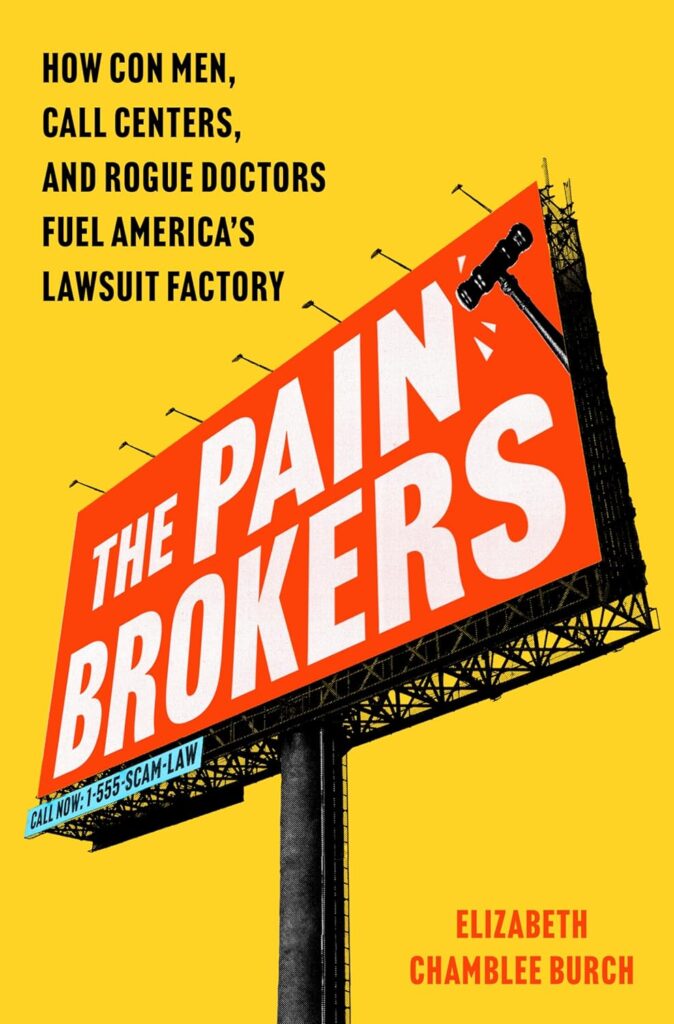
There are two types of trial lawyers.

One is the trial lawyer – as in – go to trial. A lawyer whose goal is justice for the client. Get the case before a jury and get a verdict.
The other is the settlement trial lawyer. Let’s get this case settled, get the fee, get out and get on to the next case.
But then there is another, very dark side of the trial bar.
And that’s the side that is portrayed by Georgia Law School Professor Elizabeth Burch in her new book – The Pain Brokers: How Con Men, Call Centers, and Rogue Doctors Fuel America’s Lawsuit Factory (Atria, 2026).
At the center of the book is pelvic mesh.
Roughly ten million women worldwide have mesh in their bodies. Pelvic mesh was billed as a surgical fix for stabilizing sagging organs and for incontinence. But the mesh left many of the women in diapers and with debilitating pain. The mesh was designed to treat men’s hernias and not tested for a different use in women’s vaginas.
Mesh caused the first injury.
The second injury was caused by sleazy tort lawyers and doctors who preyed on the women with mesh in their bodies, lured them to south Florida to get the mesh removed from their bodies a medical procedure that often caused more damage than the mesh itself.
What is pelvic mesh? How many women have it? And what’s the problem with it?
“Pelvic mesh is a device used for pelvic organ prolapse,” Burch told Corporate Crime Reporter in an interview last week. “As you age, gravity takes over and organs shift, just like your face does over time. It was also used for urinary incontinence. Millions of women in the United States and millions of women around the world have it. It was originally designed to deal with men’s hernias. And the manufacturing companies thought – well, if this is good enough for hernias, then it might as well be good enough for women’s vaginas, not realizing that it’s a very different area of the body, much more porous tissue, it moves with every little cough.”
“It turns out that it is terrible for use in that area. It began to unravel, it began to pierce other organs. It is not a great product. It was taken off the market by the Food and Drug Administration (FDA) in 2019. But when I started researching this it had not yet been taken off the market.”
Of those millions of women who had the pelvic mesh, how many had problems with it?
“It’s tough to say how many of the problems were due to the mesh itself. There were over 100,000 cases brought in the multi-district litigation in West Virginia. There were even more than that brought in state courts around the country. The number of people who have problems is much greater than the number of people who actually sue.”
What was the average recovery for the women who sued?
“It was pitiful. Just to give you some perspective, let’s look at the Biomet hip implant settlements that occurred a number of years before the pelvic mesh settlements began. The baseline payout for a faulty hip was $200,000. The average recovery for a mesh settlement was $40,000.”
Did the women actually get a $40,000 check?
“The $40,000 was the gross amount before the attorneys fees, costs and liens and everything else, which very quickly ate away at all if not most of that amount.”
“Three women are at the heart of the book. Each of them receive these phone calls. You can imagine, you are in your kitchen one night and the phone rings and you answer it. It’s somebody who you probably just hang up on. But the person who is calling knows a crazy amount of information about you. They know your name. They know your birth date. They know the date you had the mesh implanted. They know the name of your doctor and your hospital. And then they tell you that you have a ticking time bomb inside you and if you don’t have this mesh removed immediately, you are going to die.”
“The trick was to try to lure these women down to south Florida to these outpatient facilities that were not hospitals. These were chiropractors offices. They were surgery centers set up next to a strip mall. They had the women sign these docusign programs that were programmed to leap immediately to the signature page and autopopulate their signatures throughout the document as if they had read and signed the whole document.”
“They of course thought it was HIPAA forms and consent to medical procedures. But what was contained in those documents were attorney/client retainer agreements and a medical lien against any future settlement proceeds.”
“Mesh was not a great product, but it didn’t always need to be removed. Had they needed to have it done it would have cost insurance between $800 and $1,000. Instead it cost the women between $69,000 and $120,000 against their future settlement proceeds.”
“The idea was that if you had the mesh removed, that would increase the settlement value for the doctors, the lawyers, the middlemen and the funders. The women were left with whatever was leftover at the end of it all.”
I’ve heard you say that removing this mesh is like pulling rebar out of concrete. Was it advisable to have the mesh removed?
“It depended on the pain and where the pain was stemming from. There was a doctor at UCLA who was the one who pioneered in this area and one of the first doctors to recognize the dangers of mesh. Mesh removal surgery when done right could take between seven and eight hours. You are talking about extracting filaments from living tissue. Picture a friendship bracelet with an open weave. That was supposed to create scar tissue around your own tissue. And that would then create the hammock. You are literally extracting filaments from living tissues that are surrounded by organs. It takes a long time to do it right because the mesh itself can splinter.”
“In the South Florida cases, the doctor was removing five meshes a day. When I spoke to one of the doctors, she bragged to me that she was taking just fifteen minutes to remove the mesh. Many of the women who went through this process were left permanently incontinent. And they weren’t able to have subsequent surgeries to fix the fix of the fix.”
On the legal side, because of this form that they signed, they were signing a retainer agreement with the lawyers who would sue the companies who made the mesh and recover whatever they could.
How did that work out?
“The women were very rarely able to speak with their actual lawyers. The women in the case that I profiled never spoke with the lawyers who were signing the lien, saying they had counseled the women about the dangers of the surgery and the pros and cons of taking out the mesh.”
“The lawyers were treating the women like numbers on a spread sheet. And that was how the women felt having gone through this process.”
How did they get the medical information about these women to contact them in the first place?
“The best I can tell, the information came through a data breach in India when health insurance companies began outsourcing their recordkeeping to India. And that information was a gold mine for mass tort lawyers.”
You portray a sleazy operation that was going on at this call center in Florida. They were going through the information from India and calling women, bringing them down to Florida, having them sign the documents and then doing the surgery. And then they would bring these tort cases. But some of the mesh cases were brought by legit trial lawyers.
“Yes. There are so many good plaintiffs lawyers out there who are trying to do the right thing. This is not a story about those lawyers. This is a story about the underbelly of the mass tort world. It is certainly not as if we can paint all trial lawyers with a broad brush.”
Most trial lawyers are settlement lawyers. Very few want to take a case to a jury trial. They are risk averse. They want to get a settlement and move on to the next case. Is that your sense also?
“That is my sense as well. Some of the best lawyers are the ones who try and stay out of mass tort cases, who try to stay out of multi-district litigation – because they know they are going to lose control over their client’s case, they know they are not going to be able to effectively litigate it. And in many ways that’s a function of the system itself, which takes away the right to a jury trial.”
“When you are in the MDL scrum, you can’t credibly threaten to take your case to trial if you don’t like what the settlement offer is. Even the best trial lawyers often feel hamstrung by that practice.”
What are the institutional pressures that lead to that end?
“Settlement. You can imagine Judge Joseph Goodwin in West Virginia who had over 100,000 of these mesh cases. There is no way you can try that many cases. You have to encourage settlement. So there is pressure on both sides to reach some kind of settlement. And the companies want as many people put into that settlement as possible. They have come up with all of these kinds of settlement provisions that encourage plaintiffs attorneys to strong arm their clients into taking a settlement.”
“There are provisions that say – you are not going to get paid as a lawyer unless you have 100 percent of your clients in this deal, provisions that require you to withdraw as an attorney, to withdraw from representing any client that refuses to settle, provisions that skate and in many cases cross the rules of ethics.”
You could see this book being made into a movie.
“I am in some talks with some people now. I hope that it does happen. We’ll see what happens. I hope it works.”
There have been some great tort law movies. A Civil Action about the pollution in Woburn, Massachusetts. The Verdict – about medical malpractice. And The Rainmaker about insurance bad faith.
What are you working on now?
“I’m working on a book about Tom Girardi. He was one of the lawyers behind Erin Brockovich. He was married to one of the women on the Real Housewives of Beverly Hills. He was recently sentenced to prison for embezzling money from clients.”
For years, corporations have portrayed trial lawyers as sleazy operators. Do you worry about playing along with the corporate public relations machine?
“I do. I believe very much in the work of the trial bar. But I also think that we have reached this critical turning point. Back in 2023, one out of every two cases entering federal civil court was part of an MDL. I don’t think that the people in those MDLs feel like they have had their day in court or feel like they have been treated justly.”
What percentage of trial lawyers in America are settlement lawyers compared to actual go to trial lawyers?
“It’s very hard to tell. We are looking primarily at state court dockets and there are not great numbers coming out of state court. Very few cases actually go to trial. Somewhere between 97 percent and 99 percent of cases ultimately settle. But that is because in large part there has been a credible threat before trial. They are settling on the road to trial after discovery has determined what a settlement should look like.”
“But it is hard to put a number on what we would think of as a settlement mill firm as opposed to a trial firm.”
[For the complete q/a format Interview with Elizabeth Burch, see 40 Corporate Crime Reporter 19(12), May 11, 2026, print edition only.]
Don't Miss:
-
Rick Claypool on Pay to Play Corporate Crime Enforcement
-
Labaton Launches Whistleblower Practice with Former SEC Acting Chair Allison Herren Lee
-
Kremlin payment firm A7 has been pumping billions in ‘untraceable’ cash into global financial system
-
New US law requires dating apps to include warnings on romance scams
-
Southeast Asia Welcomes Japanese Investment but not Soldiers